Friday, November 24, 2023

Friends in Kenya

 One of the best things about having gone to Kenya lots of times is that I have friends there.  I love seeing people that I have known for years.....as well as making new friends.  

At Mgalani Boarding school, sweet Luvuno is the accountant.  Rinda met her when she was about 6 years old, a little girl leading her class in a rousing song.  Her skills, even at that age, marked her as a leader and no one was surprised when she did qualify for a Kenya Keys sponsorship. She completed college and got a certificate in accounting. Her bright smile lights up the room.  You'd never know that she is a single mom of a child with special needs and also the sole support of her mother and sister.  Luvuno is a woman of steel and I love and admire her!


Jospeh Mbotte has been our driver on each of my 7 Kenya trips.  He has one of those Kenyan megawatt smiles.  Last year I met his sweet wife Mary.  This year it was so fun to meet his daughter, Joy.  I've heard about her since she was a 5 years old and now she is a Form 4 or what we would call a 12th grader.  Joy says that she has heard about me all of her life and was excited to meet me!
Joy is the perfect name for this young woman! She's mature and personable and just a total 'joy' to be around.
I have been praying that she did well on her all-important exam and can study either nursing or IT in college.
I've been friends with Abdallah Ruwa for many years.  Last year I met his entire family.  On this trip I was visiting a 3rd grade listening to a rousing rendition of "Old McDonald Had a Farm" as a part of a lesson on domestic animals.  The teacher who just radiated happiness was Abdallah's wife.  Lucky students to have such a joyful teacher.
When I was in Kenya in 2019, our whole team noticed a young girl at Egu Primary School.  She was a talented dancer and gave several animated dramatic performances.
She's the dancer closest to Kenya Keys staff member Clemence.  
When she danced and performed at the Girl's Conference, in front of several hundred people, she had a problem with her skirt.  The button had fallen off and she had to hold it up with her hand, not an easy task while dancing.  Two of our team members managed to find her a safety pin and saved the day.
Her expressions were priceless as she recited a story to us.
Unfortunately I couldn't remember her name but I did have a photo of her from that 2019 trip so I asked Clemence, who grew up in the same community, about her.  Turns out she is attending secondary school at Mackinnon Road, which is a school we planned to visit.
Clemence got her out of class so that I could chat with her.
She is not a Kenya Keys sponsored student.  Her illiterate father is managing to pay her school fees.  He's a man who values his bright, talented daughter.  That's not always true in Kenya!  The school principal told me that she is excelling in her studies and is the star of the drama department.  No surprises there!

Did you know there is an International Friendship Day? 
I didn't until I googled and found these perfect quotes.
 If you want to celebrate next year, it's July 30th!

Friendship is the passport to a borderless world.

In the tapestry of life, friends are the most colorful threads.

Global hearts, united by friendship's art.

Friendship knows no distance, only connection.

A true friend is a gift that transcends oceans and skies.


I Am A Girl From Africa

Kenya Keys founder, Rinda Hayes, sometimes refers to Kenyan young women as 'girls of steel'.  During the years that I have been associated with Kenya Keys, I have found this title to be completely applicable.  Like steel, these young women can be bent and stretched to the maximum before breaking. They face obstacles that we can hardly imagine.  Their challenges are real, like hunger, (one meal a day is the norm), lack of sanitary supplies, the possibility of being forced by parents into an early marriage, the dangers of sex trafficking,  an illness with no medical care available, and always the fear of not having resources to achieve their educational dreams, yet their tenacity and determination, what my grandmother might have called 'sheer grit', are a wonder to behold.  

I was delighted on this trip to sit down with a group of these incredible girls to discuss the book, I Am A Girl From Africa by Elizabeth Nyamayaro. Like the girls in our discussion group, Elizabeth was born into poverty but she had a dream of becoming a UN worker.  This dream was an anchor on Elizabeth's incredible journey from a mud hut in Zimbabwe to the halls of the United Nations in New York.  Her story would be inspiring to anyone but most especially to a group of young Kenyan secondary school girls who also have big dreams.

In the book, Elizabeth's grandmother talked to her of 'shinga' - an inner strength that God gave to Africans because he 'knew that life wasn't going to be easy....shinga is inner strength but so much more - shinga means courage and to 'be strong' and it also means to 'persevere' and to be 'resilient'.   Sounds like girls of steel huh? 

When I asked these girls to share their dreams, they answered immediately.  Some wanted to be doctors or lawyers or nurses or teachers. One girl dreamed of being a human right lawyer, another a cardiac surgeon; another a social worker, one even dreamed of being an air hostess. All dreamed of education past high school.  And every single one of them longed to give back to their families and communities.

We talked about the African concept of ubuntu, which means "I am because we are, and because we are, you are'.  Ubuntu means that we share the weight of work and sorrow, and the lightness of joy and abundance.  We pray for  the sick, we bless one another each time we meet; we pray for rain and celebrate together when it arrives'.  It means that your dream doesn't just belong to you, it is a dream for all of us." This group of teenaged girls live this concept each day.  Remember the longing of each girl to give back to their families and communities?  That isn't fake.   We are seeing this over and over again as formerly Kenya Keys sponsored students who have achieved their educational dreams, now support the education of others.

The discussion of ubuntu led us to think about the heroes of the book.  Obviously, Elizabeth is a heroine of her own story but when I asked the girls who else were heroes their answers came quickly.  They named Elizabeth's grandmother who sold her cows and goats to buy her granddaughter a ticket to London.  Uncle Sam and Aunt Jane who encouraged Elizabeth in her studies.  The UN doctor who took a chance on an untrained young woman with big dreams and gave Elizabeth her first UN volunteer job.  The African proverb is "It takes a village to raise a child".  I might amend that to say, "It takes a village to make dreams come true."   Sometimes the heroes leave the village to achieve their dreams and sometimes the heroes stay at home and rejoice in the fulfilled dreams of others.

Another concept we discussed was that dreams are an anchor or a foundation.  Elizabeth says, "My dream anchors me - even when I'm tired and hungry, and even when the days are long and unpleasant".  After the discussion I had prepared an activity for each girl.  

They had the chance to design their own book cover with encouraging words or things they wanted to remember about the book. Hopefully this visual aid will be another anchor to their dreams.
What could possibly be better than discussing I Am A Girl From Africa with these 'girls of steel' who dream big dream! And who understand the African proverb, "your dream is a dream for your community".
And thanks to Kenya Keys for helping so many to have their dreams come true!


Marilyn's Fun

When we were at BYU George studied Electrical Engineering and I studied Early Childhood Education.  The areas of focus we each choose in Taru definitely reflect those majors!

I spent a couple of delightful afternoons at the Taru Community Library interacting with groups of kids.

Reading Going on a Bear Hunt and then Going on a Lion Hunt to some preschoolers


I read a cute story called Dog's Colorful Day.  It tells the story of a dog with one spot who gets more and more 'spots' throughout the day from drips and stains!  Then we used watercolor to add spots to our own dog pictures.
Schools here have few, if any, art supplies so using watercolors was a real treat for them. I suspect that Mwanaisha, our librarian, will get lots of requests to paint!  I did leave her all the supplies.
Another day, I interacted with a group of 8th graders from one of the private schools.  After playing some language games, I read them Malala's Magic Pencil.  This story is based on Malala, the Afghan girl who defied the Taliban to get an education.  In this picture book, Malala talks about what she would do if she had a magic pencil and could draw the world the way she would like it to be.  Naturally, she would draw free schools for all children - boys and girls. I gave the students a paper and asked them what they would draw if they had a magic pencil.  I have done this activity before in Kenya and the things they would draw are ALWAYS things that would benefit others.  This group was no exception.
Some of their magic pencil wishes are coming true with the construction of the Community Education Center - a big library, an e-learning center and even a football pitch!
Their selfless concern for the community is one of the many things I admire and love about my Kenyan friends.

Back in September I led an activity with the 8 - 11 year old girls at our church and talked to them about what life in Kenya would be like for girls their age.
Then they made bookmarks for me to take to the library.

In Taru, I handed out the bookmarks and then had the Kenyan kids make bookmarks for me to take back to the girls in Idaho.  It didn't work out exactly as I had planned because there were lots of very young kids at the library that day, instead of the older girls I had envisioned.  I couldn't turn little kids away and the book marks were darling....and the cute faces adorable!
These kids rarely, if ever, get the chance to use colored paper, glue sticks, stickers, markers, or scissors.
I was impressed with their creativity.
Look at those intent faces!
Because the library is in the commercial center of Taru, children whose mothers work in the market stalls, frequently hang out at the library.  This little angel stole my heart.  She was too little to make a bookmark but she was thrilled when I gave her a pink ribbon.
These children really are the light of tomorrow.
The Community Library is helping that light to shine.


Wednesday, November 22, 2023

Technology in Taru

Although on a Kenya Keys trip, many activities are done as a group, each volunteer who goes to Kenya has an area of focus.  No surprise that George's focus is technology!

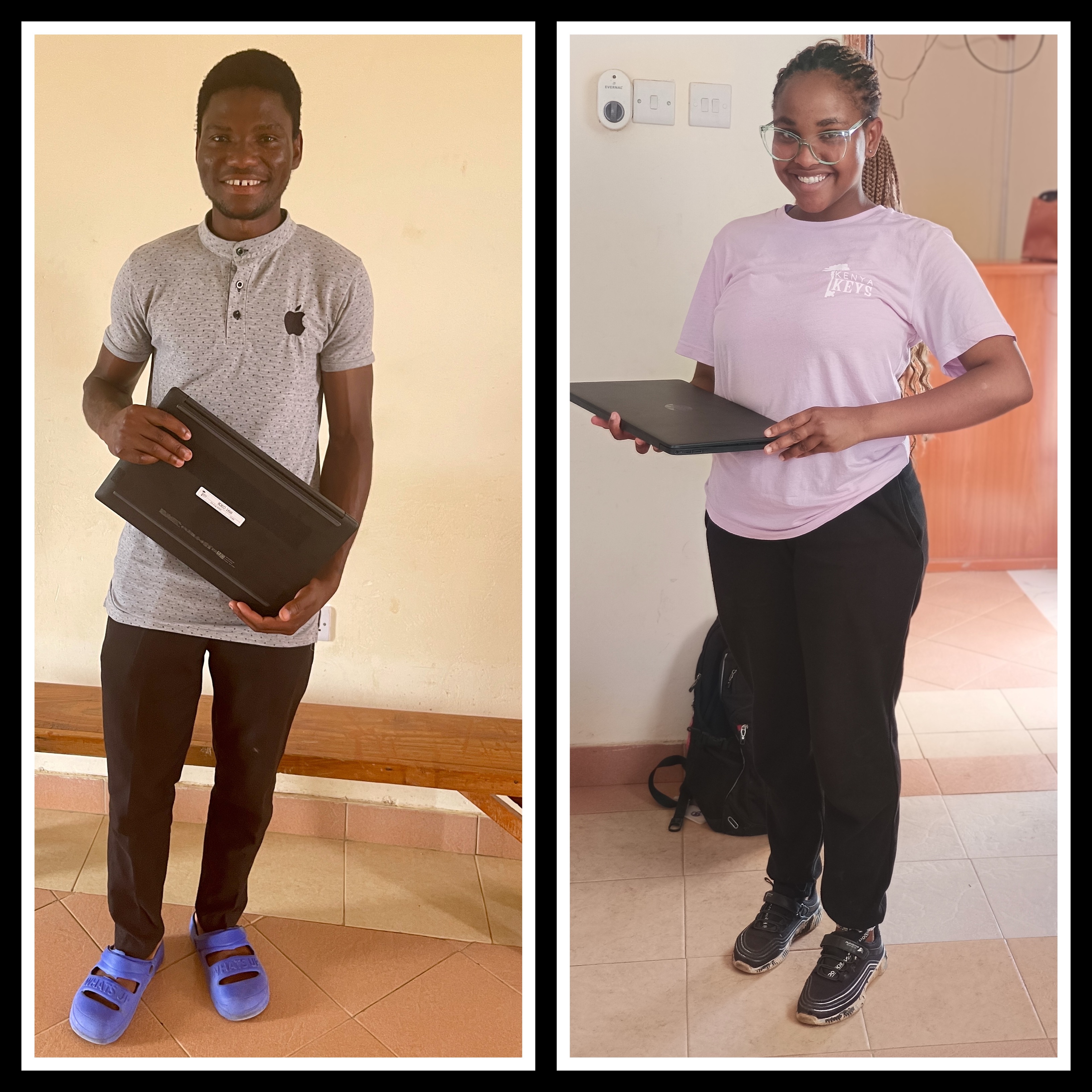
 One of his primary responsibilities is to help with the laptop program.  Sponsors and others donors will provide money to purchase laptops for college and university students.  For the first years of this program,  the engineering, math and science students were most in need of technology.  That has changed and every post-secondary student could benefit from their own laptop.  Working with his contacts at HP, George purchases laptops, sets them up with current software, gets them to team members going to Kenya and coordinates all this with Kabani on the Kenyan staff who then distributes the laptops to happy young students like these. 
Can you imagine what a game changer this is for a busy university student?

On this trip George also taught a class on the internet to secondary school students.  Unfortunately we were always busy doing something else while he taught so I didn't get a good photo of his 'human internet'.  
I'll let him explain in his own words what he did.  It was very clever and totally interactive so I am sure the kids were enthralled.  So often in Kenya the teaching is all by lecture preparing them for the rote learning necessary to score well on a test.  They LOVE interactive activities!

Exercise:  ‘human’ internet simulation


Introduce the internet as a very large set of computers that communicate with each other.  It really started with 4 computers at 4 different locations, all run by computer specialists.  As they explored what a computer could do in combination with other computers, they developed two fundamental capabilities necessary for sharing the computing load:

  1. The ability for computers to share information with each other via a ‘network’ of communication links, and
  2. The ability to select which computer to communicate with by assigning an ‘address’ to a computer, much like a postal address.

With these two functions, the internet could grow from the original 4 computers to the millions of connected computers today.


Exercise:  Have the students act as computers to show how the internet works.

  1. Select one student to be the Internet Service Provider (ISP) required to connect to the rest of the internet.  In Kenya, this is usually a company called Safaricom.   This student will handle all requests we are going to make, and they hold a sign saying Safaricom.
  2. Select several students to be the information servers.  They would specialize in various knowledge areas, like Sports, General Information, Schools, etc.   These students hold color-coded signs showing their knowledge area.
  3. Select more students to be the computers forming the path between Safaricom and the information servers.  One student in the path will have a color-coded sign to match the information server.  Depending on the class size, we had 2-4 students in each path.

All of these students were brought to the front of the class, and arranged so that the ISP was in front, the servers were in the back, and the students in the path were lined up between the ISP and the server.


Now the fun begins in showing how the internet works.  I had printed a set of color-coded cards with questions about the knowledge areas.  There was also a corresponding set of cards with the same questions, but with the answer on the back.  The cards with answers were given to the information servers.  Then I had other students volunteer to “ask the internet a question’.  They came to the front, read the question, and handed the card to the Safaricom student.  Safaricom then had to identify the path to the correct server (by matching the color of the card) and hand off the card to the student acting as the path.  They then passed it down the line of students until it reached the information server.  The server found the corresponding card with the answer and passed it back along the path to Safaricom, who handed the answer to the student asking the question.  That showed the basic operation of the internet.


A couple of times, the server started to read the answer out loud and I had to remind them that they might be 1000 km away from the student asking the question, and that they had to pass the answer through the internet back to Safaricom, who would then communicate with the questioner.   And since most students were familiar with cell phones, reminding them that asking a question through Safaricom was just like what they were already doing with their phones.   It was also fun to see them get faster in running the internet as they got familiar with how it worked.


Questions included things like:

  • What is the temperature in Nairobi?
  • Who won the Women’s World Cup?
  • Translate a Swahili phrase into English
  • What is the phone number for the Girls School?
  • When did Kenya Keys start?
  • What was the most common topic searched last year by Kenyan students?


I closed with an overview of all the types of services the internet supports, like email, knowledge searching, websites, along with guidelines for staying safe when using the internet.

George taught this class 6 times, 2 times each at 3 different secondary school. 

The other area where George's expertise proved invaluable was in technology discussions for the new building which should be finished sometime next year.  There is a lot of technology  to discuss because there is both an E-learning center (which eventually will have 50 laptops) and a huge library that will be managed by a software program.  

The Kenya Keys Community Education Center will be the largest building in the area.  The 2nd story should be added very soon. So excited!


Mattress

 A number of years ago parents and students at Egu Primary school were concerned about their low performance on the all important test after 8th grade which determines if a student can continue on to secondary school.  The solution was for the students to board at the school.  This would give them time in the evenings to study.  You see at home, there are no lights so there is no way to review or prepare.  For the first years of the boarding program, students slept on the floor or on their desks, then thanks to a very generous donor, Kenya Keys built a dormitory. Now they have bunk beds. Such happy children in 2019!

We visited Egu again this year.  I was surprised when I was in the dorm.
Since my last trip in 2019, there has been a continual drought.  Fewer parents could afford to purchase a mattress for their student.
Some students have very thin mattresses, others simply put a couple of pieces of cotton fabric down on the metal grids and sleep on that.  Can you imagine?
I think sleeping on the concrete floor would be preferable. 

Again, Kenya Keys to the rescue.
Mattresses were purchased and delivered.

A good nights sleep should help these dedicated 8th graders as they take the exam that will determine their educational future.  


What We Do in Kenya

I am often asked what we actually do while we are on a Kenya Keys trip. My answer is always that we do so many things - from visiting schools to planting trees (I always feel like a member of the royal family) from visiting old friends to long planning/brainstorming meetings. However one of the highlight is interviewing Kenya Keys sponsored students.


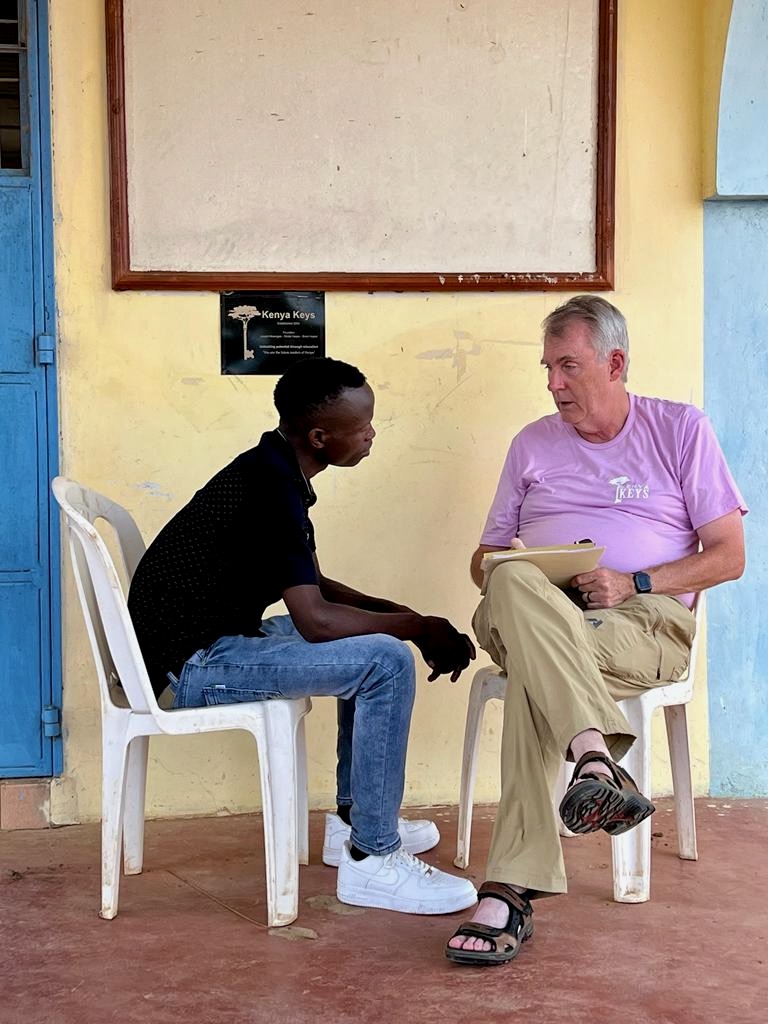
These students are almost always the first in their families to attend secondary school or high school. They are in a world that is foreign and unfamiliar as they try to navigate fee payments, transportation to their boarding schools, or even how to get the supplies they must have when there is little or no money. What should they do if there is a problem? Mom and Dad are not just a phone call away and are often not in a position to offer a solution. Interviews with visiting US team members or, more often, with the local Kenya Keys staff are a lifeline.


Students, especially those who are brand new to Kenya Keys, are quite shy and fearful at first. They don't want to say something that will jeopardize their sponsorship. The interviewer must first gain their trust. Only then can sensitive things like grades or health issues be discussed.


George spent almost the entire interview time with a student who was about to complete his degree in electrical engineering. Kindred spirits bonding over math and science!

I'm not sure who enjoyed the conversation more!
My job during interviews is to take photos.  It's so fun to coax a smile out of these bright young people.
An experience that Mark, our executive director had in October illustrates the importance of the interviews.  (written by Christy Russell, Kenya Keys US Staff member)

"When Mark sat down with Kenya Keys high school student Mwaka Sombo, he could not have anticipated the series of events her words would put into motion.
Mwaka didn’t want to bring it up, because she had already received glasses, but she still couldn’t see the chalkboard, and headaches came daily. As did toothaches, unfortunately. The throbbing in her jaw was relentless and distracting in class. And not that she was complaining, because she was grateful to be in school, but it was concerning that she and her classmates at the boarding school were losing weight; the meals were getting smaller, and so were they.

This is why Kenya Keys can’t just pay tuition for students and walk away. First, because we care so much about these students, and if they need new glasses or a tooth pulled, or if something really concerning is happening at their school, we want to hear them and help them find solutions. Second, because paying tuition and walking away wouldn’t work - perhaps some would be lucky enough to avoid a thousand pitfalls, but many would stall in their education when they didn’t have money for transportation to school, or they couldn’t untangle the error in the college’s electronic payment system, or when the government entirely changed the tuition payment protocol, or the online application was baffling and crashed repeatedly - all of which happened this year. In Kenya, as everywhere, young people succeed best when they can walk a brave, new path in the company of an experienced guide.

This is why we hire compassionate, committed, and capable local employees in Kenya who understand the obstacles these students face because they overcame them. And this is why we take teams of volunteers from the US to listen to these students and hear their stories, one-on-one, because when we unite our hearts, we end up in a better place.

Back to Mwaka, who made a 6-hour round trip to Mombasa in the company of Kenya Keys staffer Clemence to get new glasses. It was a process, but just look at Mwaka’s smile! A tooth was pulled, which was a relief. 

And soon 30 days of food were delivered to 600 students in 4 boarding schools and an orphanage."

Just in time to be sure they were well fed before their all important exams.


What better illustration of the importance of an interview!


Interruptions

 Almost 15 years ago, I started my blog with a post about the experience Mary and I had when we attended the inauguration of Barak Obama; the day we spent in what has been since called 'the purple tunnel of doom.'  Hours and hours waiting, tickets in hand, before we finally were allowed to exit the tunnel only to find out that the inauguration was over.  What a day and what a memory! The first of many I recorded in this blog.

   My goal has never been to make money on my blog by developing a huge following.  Instead, I print out my blog book each year and love the idea of having a pictorial journal for my posterity to get to know me.  My cousin, Scott Boyle, recently sent me the letters that our Grandma Boyle had written to his parents in the early 1960's.  They are a treasure to me and give a glimpse into the heart of a woman who I just thought of as 'Grandma'.  My hope is that my blog books will give future generations such a a glimpse into ME.

During the summer there wasn't a lot of excitement in our lives so I didn't post much. In September we headed off to Kenya for two weeks and I came home with thousands of photos and ideas for blog posts.  Unfortunately my computer balked at the idea of adding more photos so I spent weeks moving photo albums around, deleting photos that were stored in multiple places on the computer, and generally cleaning out.  Now that my computer was happy again,  I could start to share our trip to Kenya as well as trips to southern Utah.  

Fate intervened, last week George had a cold.  He took a Covid test that was negative.  Then I got cold symptoms, nothing that seemed too severe.  Because we were meeting friends for lunch, I decided to test myself just to be safe and, you guessed it, I was positive.  George followed a few days later with his own positive test.   This is our first bout with Covid.  I am rather proud of that!  

 
Our symptoms were mild, just really a cold that lasted for several days, mild fever, and exhaustion.
This is the first day that I have felt reasonably ok.
So no more excuses - it's time to catch up!